
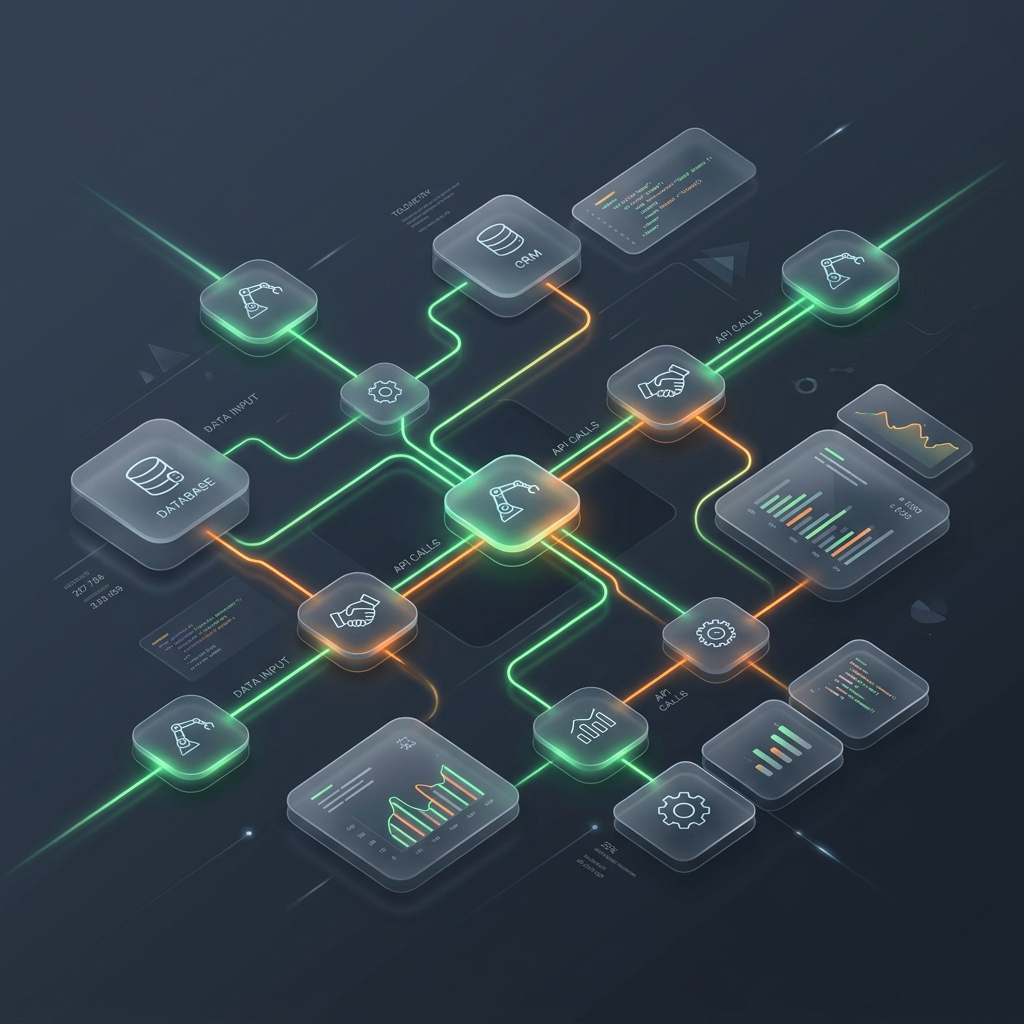
Small and medium-sized enterprises (SMEs) have traditionally relied on linear, trigger-based automations (such as Zapier workflows) to move data between business platforms. While useful, these rigid systems often break under minor variations in source data. Enter Agentic Workflows: autonomous workflows powered by Large Language Models (LLMs) that can evaluate conditions, handle edge cases, and self-correct.
The Shift to Agentic Reasoning
Unlike simple 'if-this-then-that' scripts, an AI agent utilizes semantic reasoning. When a client email arrives, the agent doesn't just copy the text; it reads it, classifies the customer's intent, references historical support logs in your database, drafts a context-aware response, and updates the CRM status pipeline. If an anomaly is detected, it flags a human manager rather than breaking the sequence.
"AI is not replacing workers; it is replacing the repetitive copy-paste workflows that restrict employees from driving high-value strategic growth."
— Vinit Vijal
Automating lead Triage & CRM Sync
Below is a simplified Node.js handler demonstration representing how an AI routing pipeline scores inbound queries dynamically and updates contact entries:
import { OpenAI } from "openai"
import { db } from "@/lib/db"

export async function processInboundLead(emailBody: string, leadId: string) {
  const openai = new OpenAI()

  // Use LLM to analyze intent and score lead budget
  const completion = await openai.chat.completions.create({
    model: "gpt-4o",
    messages: [
      { role: "system", content: "Extract budget, company size, and service intent. Score lead from 1-100." },
      { role: "user", content: emailBody }
    ],
    responseFormat: { type: "json_object" }
  })

  const { budget, intent, score } = JSON.parse(completion.choices[0].message.content)

  // Dynamically route and sync to database
  return await db.lead.update({
    where: { id: leadId },
    data: {
      intentCategory: intent,
      budgetScore: budget,
      priorityRank: score,
      status: score > 75 ? "PRIORITY_HOT" : "QUALIFIED"
    }
  })
}
The ROI of SME Automation
By moving from manual pipelines to autonomous workflows, companies save hours of administrative overhead weekly. Here is a breakdown of average time saved across our SME clients:
| Business Task | Manual Processing Time | AI Automation Time | Average Error Rates |
|---|---|---|---|
| Inbound Lead Scoring | 2 Hours/day | 0.8 Seconds | Under 0.1% |
| Custom Report Auditing | 4 Hours/week | 1.2 Seconds | 0% |
| Invoice & Receipt Reconciliation | 6 Hours/week | 2.5 Seconds | Under 0.2% |
| Customer Ticket Routing | 3 Hours/day | 0.5 Seconds | 1.5% |
Starting with automation doesn't require a full system replacement. Growing businesses succeed most by identifying their single largest operational bottleneck—whether it is customer onboarding or inventory syncing—and building a secure, custom API bridge to automate it.